Open Enrollment in Your 40s and 50s: How to Pick Benefits That Save You Money
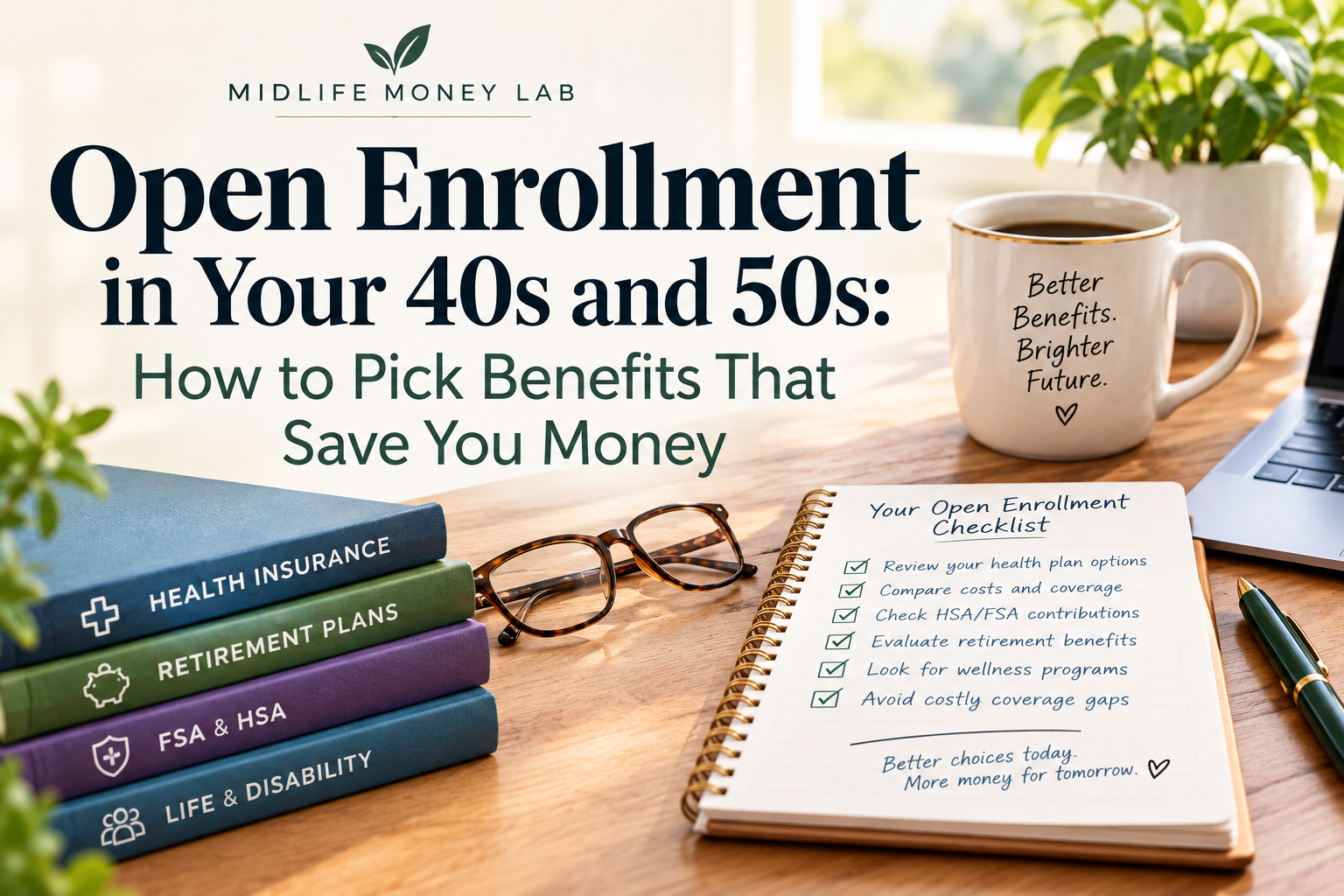
Every fall, the open enrollment email lands in my inbox, and every fall I'm tempted to click "keep my current elections" and move on. Three kids and a busy work schedule don't leave a lot of room for comparing deductibles.
But open enrollment is one of the few times a year you can change benefits that quietly cost (or save) you thousands of dollars. In your 40s and 50s, the stakes are higher: your health costs are rising, your earnings are at their peak, and more people depend on your paycheck than ever.
Here's how I work through it, step by step.
1. Don't just roll over last year's choices
Most employers let your elections carry forward automatically. That's convenient, but your life and the plans themselves change every year. Premiums go up, networks shrink, and deductibles shift.
Before you click anything, pull up last year's numbers:
What did you actually spend on doctor visits, prescriptions and procedures?
Did anyone in your family have a major health event, or is one coming (a surgery, braces, a new baby)?
Did your income, marital status or number of dependents change?
👉 Your past year of medical spending is the best predictor of which plan is cheapest for you next year.
2. Compare health plans by total cost, not premium
The plan with the lowest premium isn't always the cheapest. The number that matters is your total yearly cost: premiums + what you expect to pay out of pocket.
For each plan, estimate:
Annual premiums: the paycheck deduction times the number of pay periods
Expected out-of-pocket costs: deductible, copays and coinsurance for the care you expect to use
Worst case: premiums + the plan's out-of-pocket maximum
In 2027, federal rules cap in-network out-of-pocket costs at $12,000 for self-only coverage and $24,000 for family coverage on most employer plans, and many plans set lower caps. If you had a bad year medically, the worst-case number is what you'd really pay.
👉 Add up premiums plus expected costs for each plan. The lowest total wins, not the lowest premium.
3. Take a hard look at the HSA option
If your employer offers a high-deductible health plan (HDHP) with a Health Savings Account, it deserves a serious look. As someone who loves investing, I think the HSA is one of the most powerful accounts available:
Money goes in tax-free
It grows tax-free and can be invested
It comes out tax-free for qualified medical costs, now or in retirement
For 2027, the IRS limits are:
$4,500 for self-only coverage
$9,000 for family coverage
An extra $1,000 catch-up if you're 55 or older
To qualify, the plan must have a deductible of at least $1,750 (self-only) or $3,500 (family) in 2027. If your employer contributes to your HSA, that's free money on top.
An HDHP isn't right for everyone. If you have ongoing medical costs and little cash cushion, a plan with a lower deductible may be safer. But if you're generally healthy and can cover the deductible from savings, an HSA can double as a second retirement account. (If you're wondering whether you're on track, see how much you should have saved by 50.)
👉 If you can afford the deductible, an HSA is a tax break now and a retirement account later.
4. Use FSAs wisely (and carefully)
If you're not in an HDHP, a health Flexible Spending Account can still save you money by paying for medical costs with pre-tax dollars. For 2026, the health FSA limit is $3,400, and some plans let you carry over up to $680 into the next year. The IRS hadn't announced the 2027 limit yet when I wrote this, so check your enrollment materials for the final number.
The catch: FSAs are mostly use it or lose it. Only contribute what you're confident you'll spend, like prescriptions, glasses, dental work or therapy.
For parents, the dependent care FSA is a big one. It lets you pay for daycare, before- and after-school care and summer day camps for kids under 13 with pre-tax money. The limit is $7,500 per household for 2027 ($3,750 if married filing separately). As a single mom, I'd never leave this on the table if you have childcare costs.
👉 Estimate conservatively for a health FSA, but max the dependent care FSA if you'll actually use it.
5. Get your life insurance right
This is the part I take most seriously. If people depend on your income (kids, a partner, aging parents), you need enough life insurance to replace that income if something happens to you.
A common rule of thumb is 10 to 12 times your annual income, adjusted for your debts, your kids' ages and what you've already saved. Then check what your employer offers:
Basic group life is often free and set at 1 or 2 times your salary. That's rarely enough on its own.
Supplemental life through work is convenient, but it usually ends when you leave the job, and it can get pricey as you age.
A term policy you buy on your own stays with you if you change jobs. In your 40s it's still relatively affordable, especially if you're healthy.
If you've been through a divorce, also make sure your beneficiaries are up to date. (More on that in my year-end money checklist.)
👉 Work coverage is a good start, not a plan. Make sure your total coverage matches what your family would actually need.
6. Don't skip disability insurance
Your ability to earn is your biggest financial asset. You're far more likely to miss work because of an illness or injury than to die during your working years, yet disability coverage is the benefit people skip most.
Look for:
Short-term disability: covers a few weeks to a few months
Long-term disability: covers years, often until retirement age, typically around 60% of your salary
If your employer offers long-term disability, consider electing it, especially if it's low cost. One tip: if you pay the premiums with after-tax dollars, the benefits you receive are generally tax-free, which can make a big difference if you ever need them.
👉 If losing your paycheck for six months would derail your finances, disability insurance is worth every penny.
7. Check the extras that save real money
Many benefits packages include smaller perks that are easy to miss:
Retirement match: make sure you contribute at least enough to get the full employer match. It's an instant return.
Dental and vision: worth it if your family uses them; compare the premium to what you'd pay out of pocket.
Employee assistance programs (EAPs): often free counseling, legal and financial help.
Commuter, tuition and wellness benefits: pre-tax or free money for things you may already pay for.
👉 Read the whole benefits guide once a year. There's often money hiding in the fine print.
Final Thoughts
Open enrollment isn't exciting, but an hour of comparing plans can save you hundreds or even thousands of dollars and protect your family if the unexpected happens. In your 40s and 50s, that protection matters more than ever.
If you're rebuilding after a big life change, start with my guide on how to rebuild your finances after divorce. And if you want to avoid the most common traps of this decade, read the biggest financial mistakes people make in their 40s. It's never too late, and you can see why in is it too late to build wealth after 40?
This article is for educational purposes only and is not personalized financial, tax, insurance or legal advice. Benefit options, limits and rules vary by employer and can change, so confirm the details in your plan documents or with a qualified professional before making decisions.