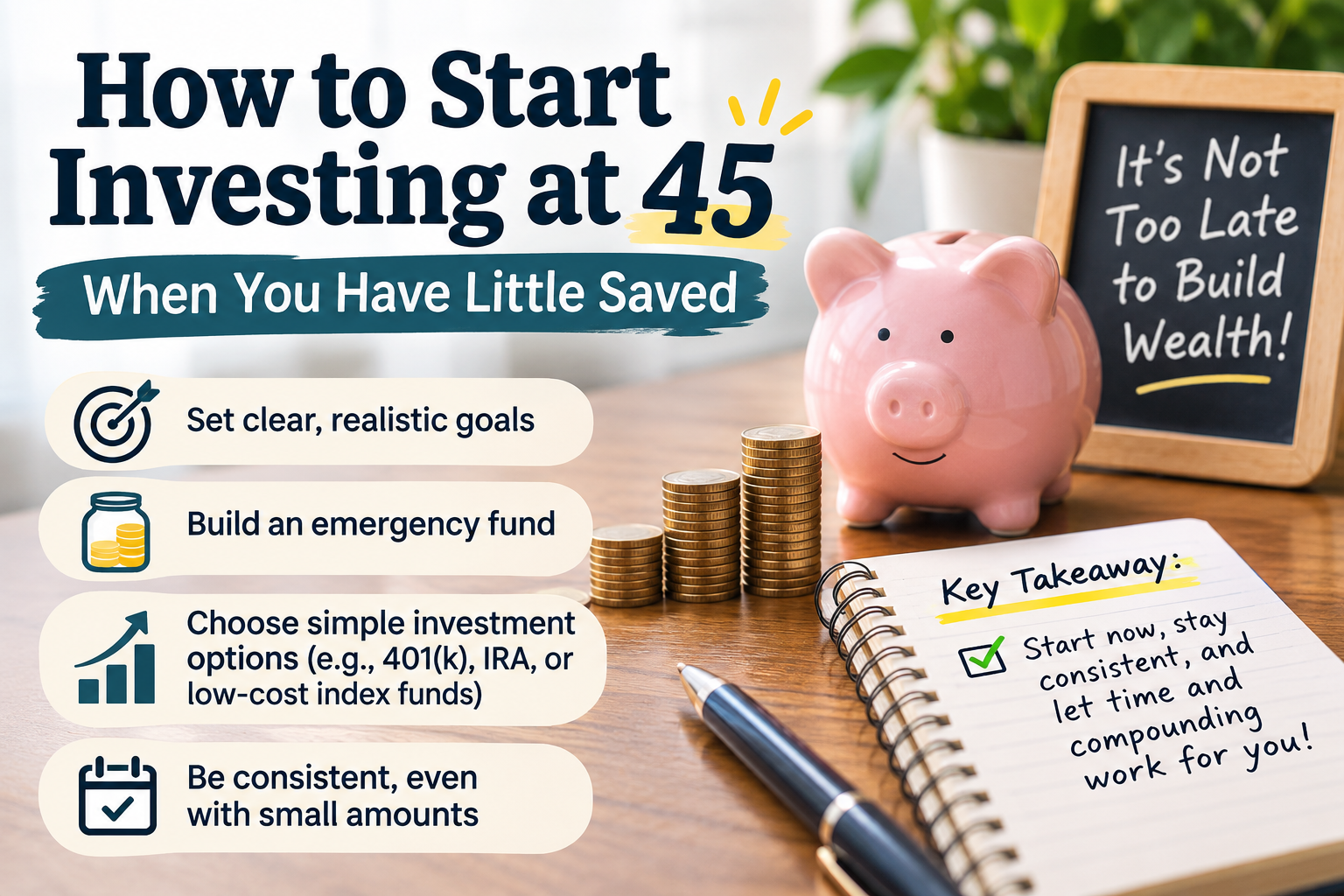
If you're 45 and your retirement account balance makes you wince, you are far from alone. Life in your 20s and 30s has a way of eating every spare dollar: kids, rent, student loans, a divorce, a job that didn't pay what it should have. Investing kept landing on next year's to-do list.
Here's what I want you to hear first: 45 is not too late. You likely have 20+ years until retirement and another 20 or 30 years after that. That's a long time for money to grow.
I've spent more than 15 years as a personal finance editor, and as a single mom of three, I know that the best plan is one you can actually stick with. So let's walk through exactly how to start investing at 45, even if you're starting close to zero.
1. Make Peace With Where You Are (Then Do the Math)
Comparing yourself to the benchmarks can be painful. But the numbers are a starting line, not a verdict. If you want a reality check, my guide on how much you should have saved by 50 shows the typical targets, and they're closer than they look once you start contributing consistently.
Here's why starting now still matters. Assuming a hypothetical 7% average annual return (not guaranteed), steady monthly investing for 20 years could grow to roughly:
$300 a month → about $156,000 (you contributed $72,000)
$500 a month → about $260,000 (you contributed $120,000)
$1,000 a month → about $521,000 (you contributed $240,000)
That's not a fortune for everyone, but it's real money, and it's money you won't have if you wait another five years. I dig into the mindset side of this in Is It Too Late to Build Wealth After 40?
👉 You can't change the last 20 years, but you can make the next 20 count.
2. Build a Small Safety Net First
Before you invest a dollar, you need a buffer so one car repair doesn't send you straight back to the credit card.
You don't need six months of expenses on day one. Start with a starter emergency fund of $1,000 to $2,000, then keep building toward three to six months of essential expenses while you invest at the same time.
Keep that money somewhere safe and earning interest, like a high-yield savings account. I compare options in Best High-Yield Savings Accounts in 2026.
👉 A cushion protects your investments from becoming your emergency fund.
3. Tackle High-Interest Debt Alongside Investing
If you're carrying credit card balances at 20% or more, paying them down is one of the best "returns" you'll ever get. No investment reliably beats that.
That said, I don't think you should stop investing completely while you pay off debt, especially if your employer offers a match. A balanced approach:
Contribute enough to get your full employer match
Throw every other extra dollar at your highest-interest debt
Once the debt is gone, redirect those payments into investments
Lower-interest debt, like a mortgage, doesn't need to be paid off before you start investing.
👉 Get the match, kill the expensive debt, then turn up your investing.
4. Grab Your 401(k) Match (It's Free Money)
If your employer offers a 401(k) or 403(b) with a match, this is your first investing priority. A match is an instant return on your money that's hard to find anywhere else.
For 2026, the IRS lets you contribute up to:
$24,500 in employee contributions if you're under 50
$32,500 once you're 50 or older (that includes an $8,000 catch-up contribution)
$35,750 if you're 60 to 63, thanks to a higher $11,250 catch-up limit
You don't need to max it out to start. Even 6% or whatever earns your full match is a strong beginning. Then raise your contribution by 1% every year, or every time you get a raise, so you barely feel it.
One newer rule to know: starting in 2026, if you earned more than $150,000 in FICA wages from your employer the year before, any catch-up contributions you make after 50 generally must go into the Roth (after-tax) side of your plan.
Open enrollment season is also a great time to review your workplace benefits. My open enrollment guide for your 40s and 50s walks through what to check.
👉 If there's a match, contribute at least enough to get every dollar of it.
5. Open a Roth IRA (or Traditional IRA)
Once you're getting your match, an IRA is a great next step, especially if your 401(k) has limited or expensive investment options.
For 2026, you can contribute up to:
$7,500 if you're under 50
$8,600 if you're 50 or older (including a $1,100 catch-up)
A Roth IRA is often a strong fit at 45 because your money grows tax-free, and you can withdraw your contributions (not earnings) at any time. Direct Roth contributions phase out at a modified adjusted gross income of $153,000 to $168,000 for single filers and heads of household, and $242,000 to $252,000 for married couples filing jointly.
Not sure which type of IRA fits you? I break it down in Roth IRA vs. Traditional IRA in Your 40s: Which Is Better?
And here's a deadline bonus: you generally have until the April 2027 tax-filing deadline to make your 2026 IRA contribution.
👉 An IRA gives you more control, more investment choices, and potentially tax-free growth.
Don't Miss the Saver's Credit
If your income is modest, you may qualify for the Saver's Credit, a tax credit for contributing to a retirement account. For 2026, the income limits are $40,250 for single filers, $60,375 for heads of household and $80,500 for married couples filing jointly. If you're a single parent, that head-of-household limit is worth checking.
6. Keep Your Investments Simple
When you're starting late, it's tempting to look for a shortcut, like a hot stock or the latest crypto craze. Please don't. Catching up is about consistency, not big bets.
Simple options that work well for beginners:
Target-date funds: Pick the fund closest to your expected retirement year (for example, a 2045 fund). It automatically holds a mix of stocks and bonds and gets more conservative over time.
Broad index funds: A total U.S. stock market fund plus an international fund and a bond fund gives you wide diversification at low cost.
Low fees: Look for expense ratios well under 0.50%. Over decades, high fees can quietly eat a big chunk of your growth.
At 45, you still have time on your side, so most people can keep a meaningful share in stocks. Just make sure you can sleep at night when the market drops, because it will.
👉 Boring, diversified and low-cost beats exciting almost every time.
7. Automate Everything
The single best thing you can do is take willpower out of the equation.
Set your 401(k) contributions through payroll so the money leaves before you see it.
Set an automatic monthly transfer into your IRA right after payday.
Turn on automatic investing so cash doesn't sit uninvested.
Schedule a yearly check-in to bump up your contribution rate.
Automation also helps you avoid one of the biggest financial mistakes people make in their 40s: waiting for the "right time" to start.
👉 What's automatic gets done. What's optional gets skipped.
8. Find More Money to Invest
If your budget is tight, there are only two levers: spend less or earn more. In midlife, the second one is often more powerful.
Trim without misery
Look for recurring costs you've stopped noticing: subscriptions, insurance you haven't shopped in years, phone plans. Redirect every dollar you free up straight into your investments.
Grow your income
A raise, a job change or a side income can move the needle faster than cutting coupons. If you're curious, I share realistic ideas in How to Make $1,000 a Month from Home in Your 40s.
Invest your windfalls
Tax refunds, bonuses and raises are perfect catch-up fuel. Try investing at least half of every windfall before it disappears into everyday spending.
👉 Every raise and refund is a chance to invest more without feeling poorer.
9. Use Your 50s as Your Catch-Up Decade
Here's the encouraging part: the system is built to help people who start late. Once you turn 50, those catch-up contributions kick in, and from 60 to 63, the 401(k) catch-up gets even bigger.
Your 40s are about building the habit and the foundation. Your 50s are when you can step on the gas, especially as kids become more independent and expenses shift.
👉 Start now so you're ready to take full advantage of catch-up contributions later.
Final Thoughts
Starting to invest at 45 with little saved can feel overwhelming, but you don't have to fix everything at once. Build a small cushion. Grab your 401(k) match. Open an IRA. Choose simple, low-cost funds. Automate it, and raise your contributions a little every year.
The most important step is the first one. Pick one action from this list and do it this week. Future you will be so glad you did.
This article is for educational purposes only and is not personalized financial, tax or legal advice. Contribution limits, income thresholds and tax rules can change, and examples use hypothetical returns that are not guaranteed. Please consult a qualified financial professional or tax advisor about your specific situation.